

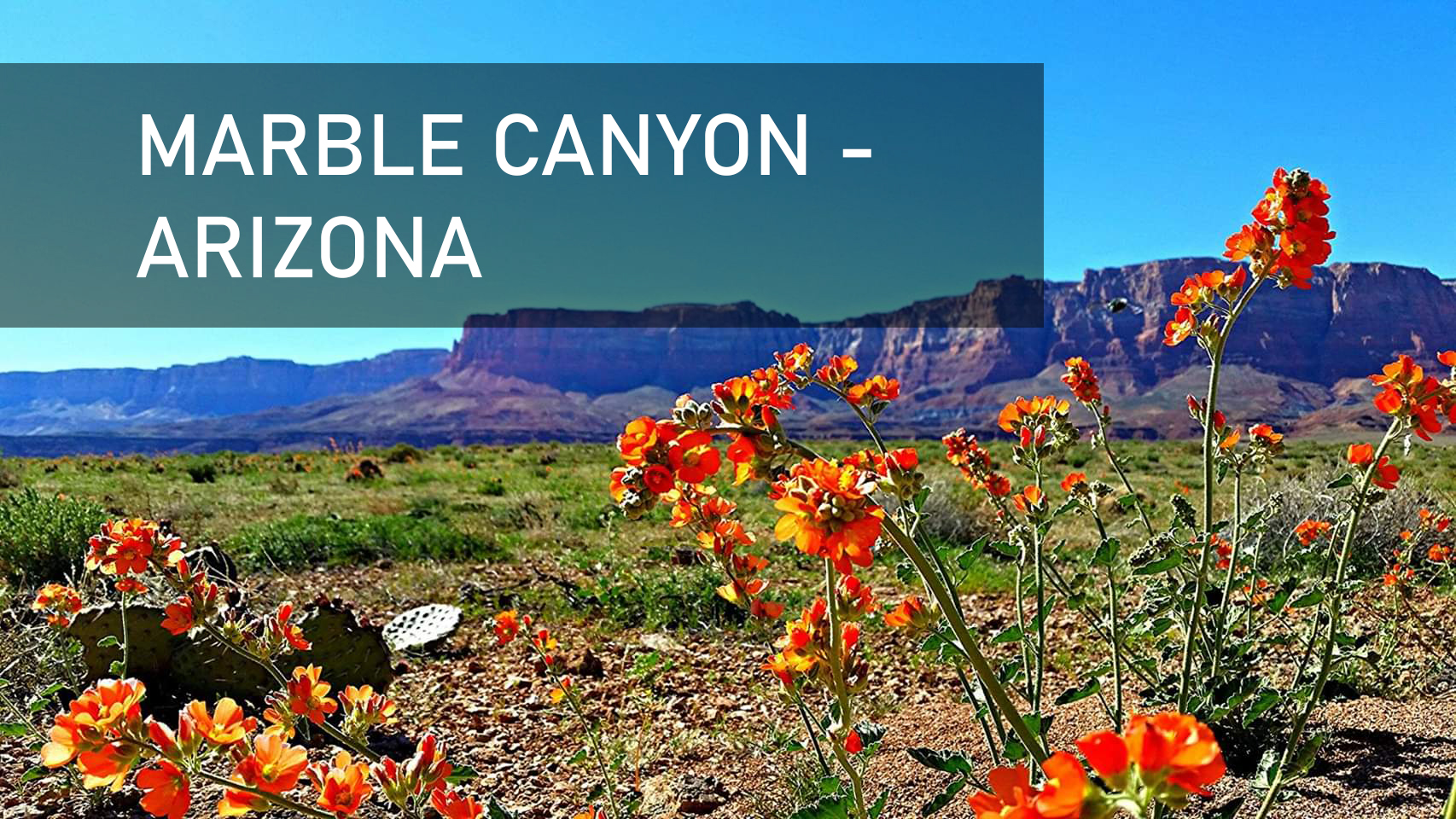
Marble Canyon – Arizona
“The limestone of this canyon is often polished, and makes a beautiful marble. Sometimes the rocks are of many colors – whites, gray, pink, and purple, with saffron tints.”
-John Wesley Powell, 1869
According to extensive research and writings by Arizona State University, Marble Canyon is flanked on the east by the Navajo Indian Reservation and on the west by House Rock Valley and the Kaibab Plateau. The canyon runs southwest for more than 60 miles from Lees Ferry to the head of the Grand Canyon.
Its name is actually a misnomer; there is no marble in this place. Powell, a self-taught geologist, knew this when he christened it. The canyon’s beautiful polished limestone struck him, and he thought it deserved this title. A little off the beaten path, the experience of Marble Canyon is best at river level. Here travelers witness the canyon’s beauty and its history.
On a nice dark night, with no interference from electric lights, this is definitely in the Top Ten locations for star gazing. Whether or not you bring a telescope, the celestial views are breathtaking. Hiking is also world class with numerous well marked trailheads. Standard hiking rules apply: good boots (no open toe flip-flops), plenty of water, hat and appropriate clothes.
Marble Canyon is truly a national gem. Among its many interesting archaeological treasures are 4,000 year old split-twig animal figurines of early desert cultures, as well as the storage granaries at Nankoweap Canyon.
The canyon holds the 12,000 year old remains of the now extinct Harrington Mountain Goat. It is home to the Pale Townsend’s Big-Eared Bat, and the highly endangered Kanab Ambersnail.
The foot of the canyon is home to one of the last populations of the endangered Humpback Chub, and the Paria River at the head of the canyon provides much needed silt and sediment for their survival.
The sheer rock cliffs of Marble Canyon make it virtually inaccessible to the outside world, but its inaccessibility has protected these natural treasures. On January 3, 1975, President Ford signed the Grand Canyon Enlargement Act, abolishing the national monument and incorporating Marble Canyon into Grand Canyon National Park. The law doubled the park’s size to 1.2 million acres.
There are far too many camping sites, RV campgrounds and tent camp locations to list here, but you might consider the only place in Glen Canyon where you can drive up to the Colorado River – Lees Ferry Campground with 54 well-kept sites. Numerous other private, National Park Service and county sites are readily available with a little online search.
Located about 1.5 miles from the boat ramp, Lees Ferry Campground provides flush toilets and a waste station for RVs. It is the perfect place to begin (or end) your Horseshoe Bend kayak adventure.
…